
 Send Inquiry
 Call Us : +905524799947

 Get A Quote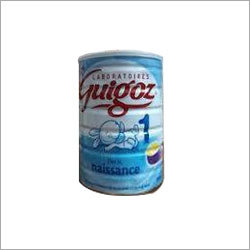
Guigoz Milk for Export
Product Details:
- Grade Premium
- Additives Enriched with Probiotics, DHA, and Prebiotics
- Application Suitable for infants from birth or as recommended by a pediatrician
- Shelf Life 24 months
- Moisture (%) Not more than 5%
- Protein (%) Around 12%
- Preserving Compound Antioxidant added
- Click to view more
X
Guigoz Milk for Export Product Specifications
- Milk
- Powder
- Foil pouch and cardboard box
- Store in a cool, dry place. After opening, consume within 3 weeks.
- Infant Milk Formula
- Not more than 5%
- Contains essential vitamins and minerals
- Mild and Creamy
- 400g
- Guigoz Milk for Export
- Around 12%
- Approximately 26%
- Antioxidant added
- Premium
- Enriched with Probiotics, DHA, and Prebiotics
- Skimmed milk, Reduced minerals whey, Vegetable oils, Lactose, Minerals, Vitamins, Emulsifier, L-Lysine, Probiotics, Prebiotics
- 24 months
- 6.5 - 7.0
- Suitable for infants from birth or as recommended by a pediatrician
- Easy to digest, Promotes healthy growth and development
- Infant Nutrition
- Powdered
- As per packaging
- 520 mg/100g
- Mix recommended scoops of powder with lukewarm water; shake well.
- Infants below 12 months
- As per packaging
- 480 kcal
- Around 56%
- Contains milk and soy
Product Description
| MULTI TEXT LANGUAGES ON TINS Typical Chemical and Physical Analysis | ||
| Moisture | 3.0 % max | AS2300.1.1 1988 |
| Fat | 28.0% min | AS2300.1.3 1988 |
| Acidity | 0.14 % max | ADPI916 1990 |
| Ash | 5.0 - 6.0% | AS2300.1.5 1988 |
| Lactose | 39.0% type | Caculated |
| Lechithin | 00:20% type | NIRO 22a |
| Insolubility Index | 0.5 ml max | AS2300.4.4 1994 |
| Scorched particles | Disc A/ 32.5gm max | AS2300.4.5 1994 |
| Bulk Density | 0.44 - 0.50 g/ml | AS2300.4.3 1994 |
| Flavour & Odour | Good | AS2300.4.2 1994 |
| Appearance & colour | Normal | AS2300.4.2 1994 |
| Wettability | 10 sec max | IDF 87 1979 |
| Dispersibility (20 secs) | 80% min | IDF 87 1979 |
| Vitamin A | 2350-3650 IU | NZ MAF (WOOLARD) |
| Vitamin D | 300 IU min | AOAC 981.17 1990 |
| Phosphatase | <2 ug p'n-phen/ml | AS2300.1.10 1988 |
| Inhibitory substances | <0.003 ug / ml | AS1766.3.11 1991 |
| Typical Microbiological Analysis | ||
| Standard Plate Count | 10,000 / g max | AS1766.2.1 1991 |
| Coliforms | Not detected / g | AS1766.2.3 1992 |
| Yeasts & Moulds | 10 / g max | AS1766.2.2 1994 |
| Coagulase positive Staph | Not detected / g | PSL 2.1 |
| Salmonella | Not detected / 1500g | PAGE 1 |
| Nutrition Information | ||
| Energy | 303 kj/100ml |
|
| Sodium | 47 mg/100ml |
|
| Calcium | 117 mg/100ml |
|
Nutrient-Rich Formula for Infants
Guigoz Milk for Export contains balanced macro and micronutrients, including approximately 56% carbohydrates, 26% fat, and 12% protein per 100g. It is enriched with vital elements such as calcium, antioxidants, and added probiotics, DHA, and prebiotics to support infants overall development and digestive health.
Simple Preparation and Safe Storage
Preparing Guigoz Milk is easy: simply mix the recommended number of powder scoops with lukewarm water and shake well. The powder form ensures freshness and convenience. For best results and safety, store the product in a cool, dry place, and use it within three weeks after opening.
Premium Quality and International Standards
Manufactured, distributed, and exported from India, Guigoz Milk for Export comes in protective foil pouches and sturdy cardboard boxes. Each batch is marked with its manufacturing date and batch number on the packaging, reflecting its adherence to high quality and safety benchmarks for infant formulas.
FAQs of Guigoz Milk for Export:
Q: How do I prepare Guigoz Milk for Export for my baby?
A: Combine the recommended number of scoops of Guigoz Milk powder with lukewarm water, then shake well until fully dissolved. Ensure you follow the specific mixing instructions provided on the packaging for proper nutrition.Q: What are the main nutritional benefits of Guigoz Milk for Export?
A: Guigoz Milk offers a balanced profile with 480 kcal per 100g, around 56% carbohydrates, 26% fat, and 12% protein, as well as 520 mg of calcium. It is enriched with vitamins, minerals, probiotics, DHA, and prebiotics to support healthy growth and digestion in infants.Q: When should I use Guigoz Milk for Export for my infant?
A: This formula is suitable from birth through 12 months, or as recommended by your pediatrician. Use it as a sole nutrition source or a supplement for infants who are not exclusively breastfed.Q: Where should I store Guigoz Milk once opened?
A: After opening, keep Guigoz Milk in a cool, dry place. To maintain freshness and safety, it should be consumed within three weeks of opening the package.Q: What is the shelf life of Guigoz Milk for Export?
A: Guigoz Milk has a shelf life of up to 24 months from the manufacturing date, which is indicated on the product packaging. Always check the manufacturing date before use.Q: Does Guigoz Milk for Export contain any allergens?
A: Yes, this formula contains milk and soy. It is unsuitable for infants with allergies to these ingredients. Always consult your pediatrician if you have concerns about allergens.Q: What benefits does Guigoz Milk offer for infant development?
A: The formula contains added probiotics, DHA, and prebiotics to promote easy digestion, healthy brain development, and overall robust growth in infants under 12 months.Tell us about your requirement

Price:
Quantity
Select Unit
- 50
- 100
- 200
- 250
- 500
- 1000+
Additional detail
Mobile number
Email

Other Products in 'Instant Baby Food' category

Contact Us

- Kurtulus Meydani Inonu Bulvari No. 70, Klas Plaza A Blok, Kat 13 D.24-26,Mersin - 33940, Icel, Turkey
ABBAY TRADING GROUP, CO LTD

- Mr. Chris Jones (Sales Manager/Sales)
- Mobile : +905524799947
- abbaytradings2015@gmail.com
- Mr. Chris Jones (Sales Manager/Sales)
Whatsapp +90 552 479 9947
Video
 Send Inquiry
ABBAY TRADING GROUP
All Rights Reserved.(Terms of Use)
Developed and Managed by Infocom Network Private Limited.
Developed and Managed by Infocom Network Private Limited.

